A delayed shipment can affect more than the delivery system. An order may need attention, stock availability may have changed and a customer commitment may be at risk. An event-driven AI agent starts with that reported change and investigates the context needed for a next step.
An event is a signal that something happened. A webhook, connector, queue or event bus can deliver it to a service that starts a workflow. An agent can then use the event and its authorized tools to look up relevant information, prepare a recommendation or carry out a permitted action. The event triggers work; it does not make the resulting decision correct by itself.
From An Event To A Bounded Response
A practical workflow filters the incoming signal, checks whether it is relevant and retrieves the records needed for the task. The agent proposes an outcome within a defined scope. The application validates the proposed action and either carries it out, asks for review or records that it cannot proceed.
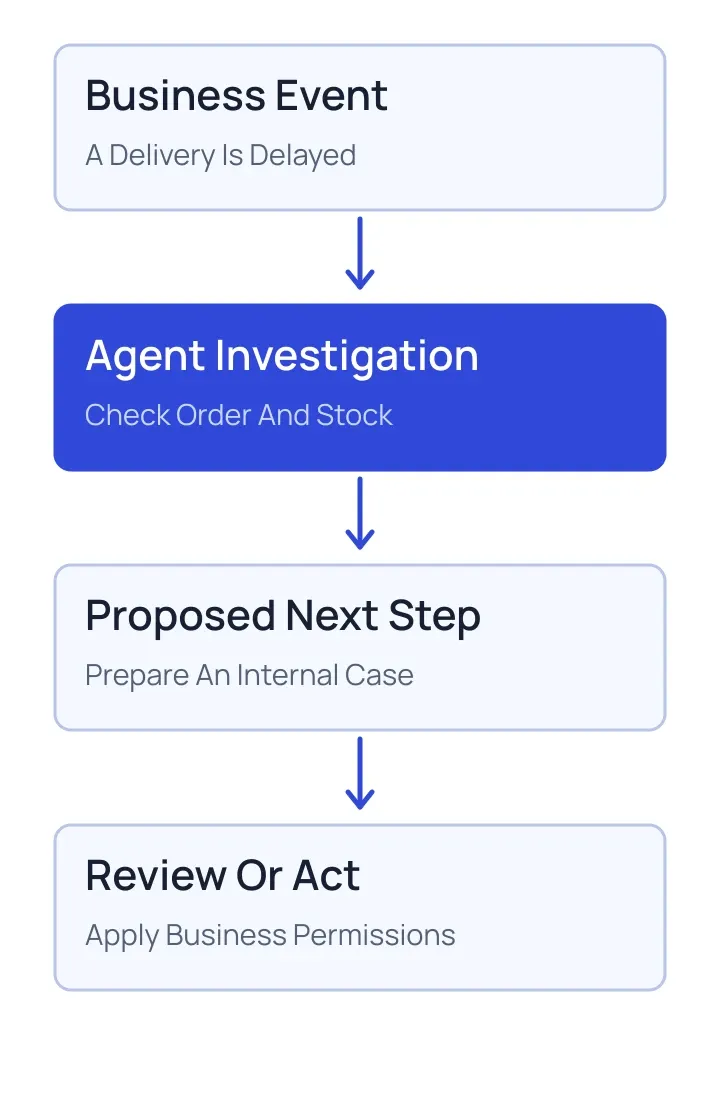
Imagine a carrier reports that a shipment is delayed. The event identifies the shipment, allowing the workflow to look up the order, the latest carrier status and available stock. The agent might prepare an internal case explaining which commitment could be affected. If a replacement order or customer message requires approval, the workflow should present that proposed action to an authorized person.
This is an illustrative scenario, not a claim about a particular customer or deployment. Whether a useful answer is possible depends on the available records, their freshness and the permissions of the connected systems.
Decide What Should Trigger An Agent
Not every event needs a model. A deterministic rule may be sufficient to update a known status, while a scheduled report may suit work that is not time sensitive. An agent becomes more useful when the next step depends on interpreting several pieces of context or choosing among bounded options.
Define an event contract: its type, source, occurrence time and stable identifier, along with the data needed to find the relevant record. Verify that the sender is authorized. Filter out events that do not need investigation, and establish limits for bursts of activity so the system does not create a flood of duplicate cases.
The Microsoft event-driven architecture guide explains common producer and consumer patterns. A separate event bus is one option; a direct webhook can also start a workflow.
Plan For Duplicates And Uncertain Outcomes
An event may arrive more than once, arrive late or appear after a newer update. Store a stable identifier and check whether the relevant work has already been completed. Design actions to be idempotent where the destination supports it: repeating the same logical request should not create another case or repeat a charge.
A timeout is not proof that an external action failed. If the receiving system accepted a request but the response was lost, an immediate retry can duplicate the effect. Check the destination for the existing result or use its supported idempotency mechanism. When neither is possible, flag the uncertainty for review.
Set bounded retry policies and record failures for later investigation. The durable execution guide explains recovery and uncertain side effects in more detail.
Keep Authority Outside The Model
Give tools the minimum permissions needed for the task. Validate the event source, filter data by the requesting or responsible user's access, and enforce business rules when a tool is called. A retrieved document or event payload cannot grant additional authority.
For sensitive changes, show the reviewer the actual proposed action and its context. Record the event, relevant tool outcomes and approval decision without storing unnecessary private information. Agent observability helps teams investigate a run when an event was missed or a tool failed.
Start with one event and a small set of safe outcomes. Test a normal event, a duplicate, stale data, a missing record and an external timeout before expanding the workflow. A useful agent is one that can explain when it needs help as well as when it can proceed.