

A support question can contain both an exact identifier and a description in everyday language: “Why does error E42 block checkout?” A keyword search may find a document containing E42. A semantic search may find a passage describing a similar checkout failure even if it uses different words. Hybrid search combines these retrieval methods to produce candidates for review or for an AI answer.
The two paths answer different questions. Lexical retrieval matches indexed terms; vector retrieval compares numerical representations of a query and content. Neither guarantees that a result is accurate or that a generated response will use it correctly.
How Hybrid Retrieval Works
A common design runs a keyword query and a vector query against the same collection or related indexes. Each returns a ranked list. The system combines the lists into a set of candidates and may apply a separate reranker before selecting passages for an answer.
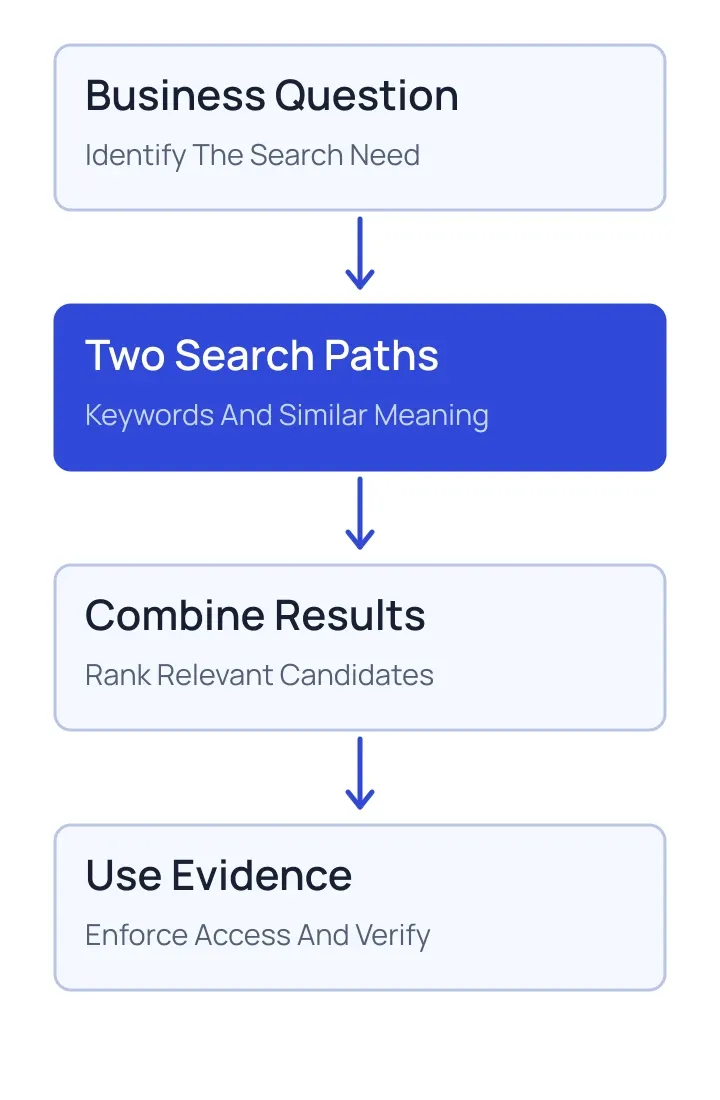
Reciprocal Rank Fusion is one way to combine lists by rank positions instead of assuming that the raw scores from different search methods are directly comparable. It is not the only design. The Microsoft hybrid search overview describes one implementation that runs text and vector queries together and merges the results.
In the hypothetical E42 example, an exact-code match could provide a troubleshooting note while a semantic result supplies useful background about checkout failures. The latter is not proof that it describes E42. The application should preserve source references and avoid presenting an unsupported connection as fact.
Build The Index For The Questions
Exact identifiers are useful only if indexing and query handling preserve them. Tokenizers can split punctuation, so test product codes, error IDs and version strings as users actually type them. For semantic retrieval, choose how documents are divided into passages and how updates are reflected in the index. A passage without its title or surrounding context may be difficult to interpret.
Consider freshness and coverage. A beautifully ranked result cannot compensate for a missing document, an outdated policy or a source that no longer applies. Record when content and permissions were last synchronized, and make updates or deletions propagate according to a clear process.
Apply Permissions To Both Search Paths
An AI assistant should only receive documents the requesting user is allowed to access. Enforce authorization across keyword and vector retrieval, including any subsequent reranking or caching. A relevance filter is not automatically an access-control system; the application must authenticate the user and apply the appropriate document permissions consistently.
Test access changes as well as the initial configuration. If a user loses access to a document, stale index permissions must not keep exposing it. Some systems support filters at different stages, with tradeoffs for recall and implementation-specific security behavior. Review the actual configuration rather than assuming all paths inherit the same restrictions.
Evaluate Retrieval Before The Answer
Build a small set of real or safely anonymized questions, including exact codes, paraphrases, ambiguous queries and questions with no valid answer. For each, identify useful sources and sources that should not be returned. Compare keyword-only, vector-only and combined retrieval using the same cases. Measure whether useful authorized passages appear near the top and inspect failures manually.
Then evaluate the answer separately: does it accurately use the retrieved material, cite the relevant source and acknowledge missing evidence? A relevant search result is not a guarantee of a correct answer. If the evidence is weak or absent, the assistant should say so.
Hybrid search is one way to find candidate context, not a replacement for a broader context engineering strategy. The best approach depends on the documents, questions, permissions and acceptable response time in the application.