A warehouse team considering a new layout faces a practical question: what might change before anyone moves a shelf? A digital twin can bring together a model of a real operation and relevant data about its state, creating a place to examine the operation and, where the model supports it, explore possible scenarios.
The phrase has several definitions. In practice, the useful questions are what the model represents, which real-world data keeps it current, how it is used and how closely its behavior has been checked against the operation. A visual dashboard or simulation alone does not necessarily provide the same ongoing connection to the real system.
From An Operation To A Working Model
A team first defines the physical system and the decision it wants to support. It identifies relevant data sources, represents the parts of the operation that matter and establishes how updates reach the model. A simulation or analytical tool can then explore a proposed change, with results reviewed against the assumptions and available evidence.
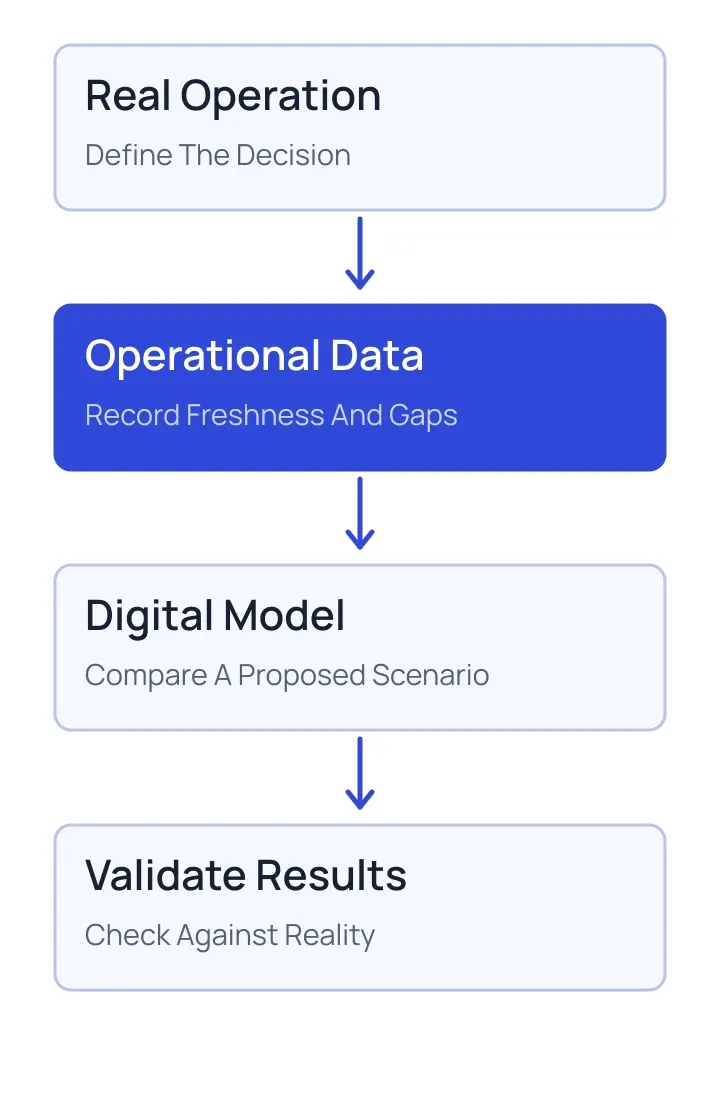
In a hypothetical warehouse, the model might include storage locations, travel paths and information about order flows. A team could compare a proposed layout with the current arrangement. That comparison is useful only if the model represents relevant constraints, such as aisle access, staffing and the types of orders being handled. A predicted improvement is a hypothesis until the team checks it against the real operation.
The NIST digital twin research overview notes that definitions and capabilities vary across fields. Some systems synchronize frequently or support two-way control; neither behavior should be assumed for every implementation.
Choose Data That Supports A Decision
Begin with a concrete question, such as whether a layout creates a bottleneck or whether a maintenance plan can fit a production schedule. List the data that affects the answer and who owns each source. Sensors, inventory records, operating schedules and manual observations may all contribute, but their quality and update frequency can differ.
Make missing and stale data visible. A model that silently uses yesterday's inventory levels for a time-sensitive decision may be misleading. Record timestamps, flag gaps and decide how the system should behave when a source is unavailable. More data is not automatically better if it adds noise or cannot be maintained.
Test Scenarios Without Overstating Certainty
A simulation uses assumptions about how a system behaves. Document those assumptions, compare model outputs with observed operations and test a range of plausible conditions. Ask what the model leaves out and whether the result changes when uncertain inputs change.
For the warehouse example, test busy and quiet periods rather than relying on a single average day. Review whether the model captures constraints such as shared equipment and unusual orders. If the available evidence is too weak, present the result as uncertain and collect more information before making a costly change.
Keep People And Controls In The Loop
Operational data can reveal sensitive processes or infrastructure details. Restrict who can view the model, protect the connections to source systems and review how long data is retained. A digital twin that can send commands back to physical equipment has a different risk profile from a read-only planning model. Any control path needs explicit authorization, validation and a safe way to stop or override it.
Start small: select one decision, one bounded part of the operation and a way to compare the model with reality. Agree who maintains the model after the pilot. A useful twin is not simply a detailed picture; it is a maintained representation that helps people make a better-informed decision while making uncertainty visible.