A model is developed using data that describes a particular period and population. Later, the information it receives may look different: customers may buy new products, a sensor may be replaced or an upstream system may change how it formats a field. Data drift is a change in the distribution of input data over time.
Drift is a reason to investigate, not proof that the model is inaccurate. Some changes are expected, and a model can perform poorly even when its inputs look stable. Monitoring needs to connect a signal to a practical decision.
Compare Current Data With A Useful Baseline
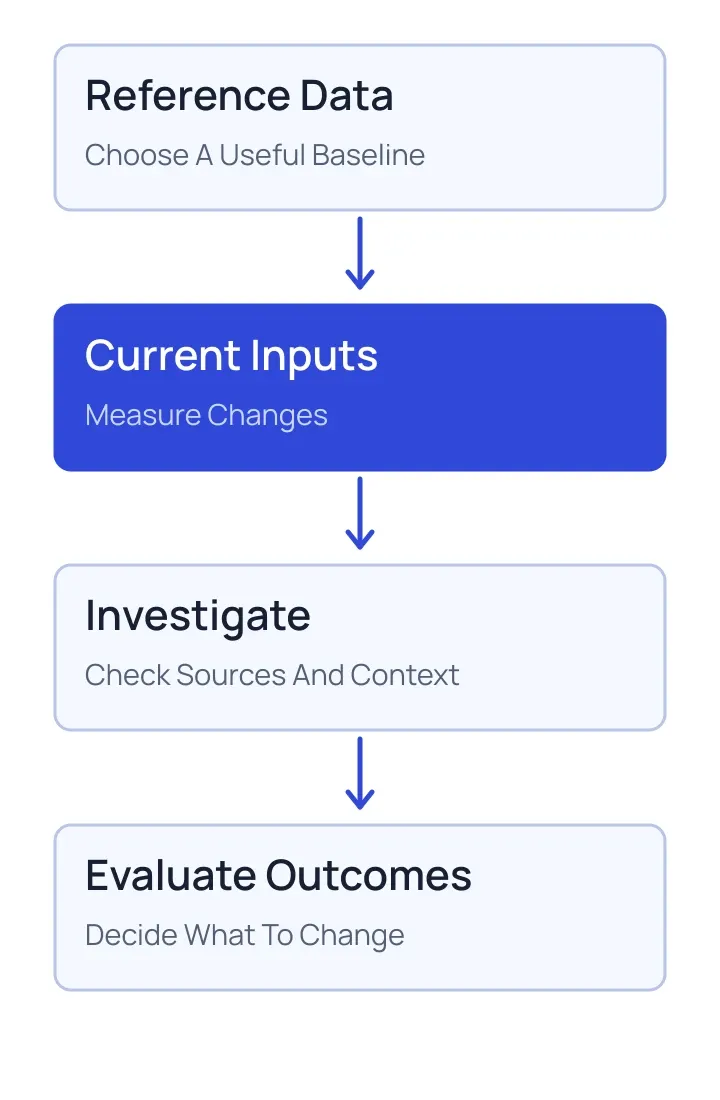
Choose a reference period that represents the model's intended use. Compare it with recent production inputs using measures suited to each field. A numerical feature might be reviewed for its range and distribution; a categorical field might be checked for new values, missing values or changes in frequency.
Imagine a hypothetical demand forecast trained on established buying patterns. A new product category changes the mix of incoming orders. A monitoring rule flags that change, and the team checks whether it reflects a genuine business shift, a source-data error or a seasonal pattern already understood by the business.
The reference itself matters. Comparing a holiday week with an ordinary week may produce an expected difference. A baseline that is outdated, biased or too small can hide a real problem or create noisy alerts. Keep its purpose and selection criteria documented.
Separate Input Changes From Outcome Quality
Input drift concerns what the model receives. Changes in the relationship between inputs and outcomes are a different problem, often called concept drift. A shift in input distribution does not necessarily change the model's accuracy, and unchanged inputs do not guarantee that the relationship remains stable.
Where reliable outcomes become available, compare predictions with what actually happened. The delay between a prediction and its outcome matters: a forecast may not be assessable until weeks later. Track coverage and missing labels so a small or unrepresentative set of outcomes is not mistaken for the full picture.
Check performance for meaningful groups where data and permissions allow. An overall average can conceal a deterioration in a particular product, region or customer journey. Protect individual privacy, and avoid drawing strong conclusions from very small samples.
Investigate Before Retraining
When an alert fires, start with the data pipeline. Did a source system change a field? Are records late, duplicated or missing? Was a unit converted incorrectly? If the inputs reflect a real change, evaluate the current model on recent representative cases before deciding what to do.
Possible responses include correcting a pipeline, changing the baseline, adjusting how cases are routed, seeking more examples or testing a revised model. Retraining can introduce new errors or embed poor data; it should be evaluated against the current model and reviewed before release. A rollback and a clear owner for the decision matter as much as the alert.
Make Monitoring Actionable
Set thresholds based on the data and the cost of false alarms. Review them as the system and business change. Record the signal, investigation and outcome so teams can distinguish recurring noise from a real issue. Restrict access to monitoring data and avoid keeping sensitive fields solely because they might be useful later.
Start with a few features tied to important decisions and a reliable way to compare predictions with outcomes. For changes to the model itself, shadow testing can provide another view before a candidate is used live. Monitoring is most useful when someone knows what action a signal could lead to.