Tests are essential, but they examine selected examples. Formal verification offers another way to reason about software: express a precise property and use mathematical techniques to check whether it follows under a stated model and assumptions. AI can assist with parts of that work, including drafting specifications or suggesting proof steps, while an independent checker verifies a completed proof against its formal statement.
The crucial question is not simply whether a proof passed. It is what was proved, which assumptions were used and whether the formal statement captures the real requirement.
What A Checked Proof Establishes
Consider a hypothetical payment component with a rule that a charge must not exceed the authorized amount. Engineers first define the inputs, the relevant code or model and the exact condition to be checked. A proof assistant or verification tool can then check whether the property follows for the cases represented by that model.
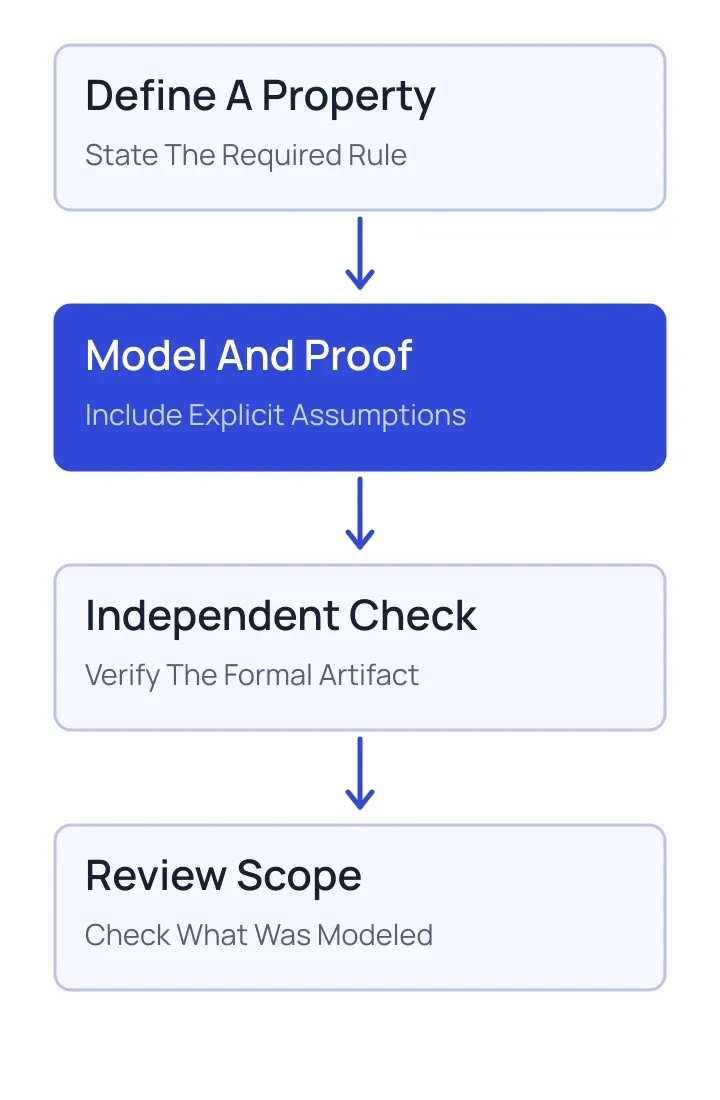
A successful proof is meaningful within its scope. It does not automatically prove that the surrounding application is secure, that an external payment provider behaves as expected or that the business rule was written correctly. If the specification omits refunds, currency conversion or an authorization change, the proof does not silently cover them.
Formal methods include different techniques, such as model checking and proof assistants, with different constraints and outputs. Some explore a finite state model; others check mathematical proofs against formal definitions. The verification method needs to fit the property and the system.
Where AI Can Help
A model can propose a formal statement from a requirement, suggest a proof tactic, identify a missing case or explain a failed attempt. These suggestions can reduce some repetitive work, but they remain candidates for review. A fluent explanation is not a proof, and a generated specification can faithfully encode the wrong requirement.
Keep the proof checker separate from the model generating suggestions. The checker evaluates the formal artifact against the language and rules of the chosen system. Engineers still need to review the statement, the implementation being connected to it and the assumptions on which it depends. The Lean reference describes a proof assistant and its language; it is one approach, not a requirement for all formal verification.
Start With A Valuable Property
Choose a narrow property whose failure would matter and whose behavior can be described precisely. Examples might include an authorization rule, an accounting invariant or a condition on state transitions. Identify the code and inputs involved, what must always hold and what the environment is assumed to do.
Make the assumptions visible. If a proof assumes a database operation is atomic, check whether the deployed system provides that guarantee under the relevant failure conditions. If it assumes an input is valid, verify where that validation happens. A strong proof of an unrealistic model can give false confidence.
Review the specification with the people who understand the business requirement. Ask for counterexamples: can the stated rule be satisfied while the actual intended behavior fails? Maintain examples and test cases alongside the formal statement so reviewers can understand both the rule and its boundaries.
Use Proofs Alongside Tests
Tests exercise integrations, deployed configuration and scenarios outside a formal model. Monitoring can reveal failures that arise from real traffic and changing external systems. Formal verification can complement those practices by establishing a particular property across the modeled cases.
Start with a small pilot and document the property, proof status, assumptions and unverified surroundings. Recheck the proof when relevant code or dependencies change. Our guide to AI agent evaluations explains how representative tests can assess behavior that is difficult to express as one formal property.
The value is a clearer claim about a specific part of a system. Treat the checked proof as evidence within a defined boundary, and keep reviewing the boundary itself.